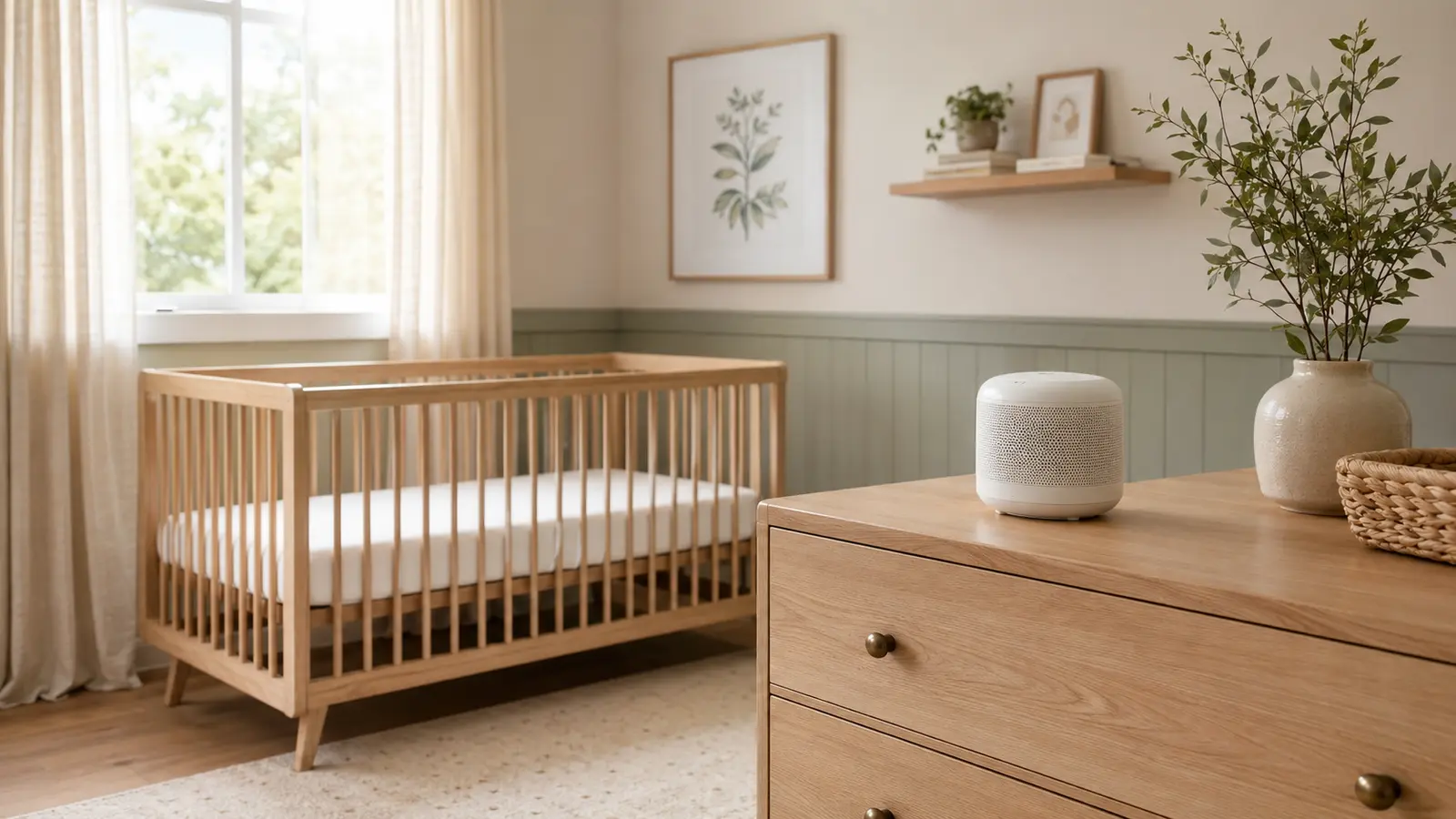
A white noise machine can soften sudden household sounds and become one small cue in a bedtime routine. It is not a treatment for frequent waking, and it should never be used so loudly that it covers a baby’s cries or exposes them to unnecessary noise.
You do not need a machine marketed specifically for babies. The useful features are low, controllable sound; safe placement; and controls you can manage consistently.
Start with placement, not sound choice
Put the machine outside the crib on a stable surface, as far from the baby’s head as practical while still useful. Keep the device, cord, charger, batteries, and any small parts completely out of reach. Never attach it to the crib rail or place it inside the sleep space.
Choose precise volume control
Look for small, predictable volume steps and a setting that stays low. Begin at the lowest useful level. If adults have to raise their voices near the crib, the machine is too loud. Phone sound-meter apps can vary and are not a substitute for professional measurement.
Compare steady sounds
White noise, pink noise, fan-like hums, rain, and other labels describe different sound profiles. There is no single “best” one for all babies. Choose a gentle, steady sound rather than a track with sudden changes, voices, or sharp peaks.
Decide whether you want a timer
A timer can switch the sound off after settling; continuous play avoids a change in the room later. Evidence does not establish one choice as necessary for healthy babies. Pick the option that lets you keep the volume low and the routine simple.
Check what happens after a power cut
Some machines restart at the previous volume, some reset, and some stay off. A memory function can be convenient, but verify that it cannot unexpectedly resume at a high setting.
Think through power and cords
A plug-in machine avoids battery changes. A rechargeable model can help during travel or outages. In either case, route every cable well away from the crib and changing area, and follow battery and charging instructions.
Treat apps and smart features as optional
Remote control may stop you entering the room, but it also adds a phone, connection, account, and possible privacy settings. Check whether the device still works without Wi-Fi and whether basic volume control remains available on the machine.
A night-light should stay dim
If the machine includes a light, make sure it can be turned off independently and does not shine directly toward the crib. Decorative projections and color programs are optional; they do not make the sound safer or sleep more restorative.
Choose a shape that is easy to clean
A stable base, covered controls, and a wipeable exterior are practical. Keep liquids away from speakers and charging ports, and follow the cleaning instructions.
Portable does not mean crib-safe
Travel machines often include clips or loops. Keep them out of the sleep space and away from handles, cords, and fabric near the baby. At your destination, set up the same firm, flat, empty sleep surface you use at home.
Know what white noise cannot fix
Noise cannot make an inclined sleeper, lounger, adult bed, or cluttered crib safe. It cannot assess hunger, illness, breathing problems, or pain. If sleep changes suddenly or your baby is hard to wake, breathing unusually, feeding poorly, or seems unwell, contact a clinician.
Quick buying checklist
- Stable device that stays outside and away from the crib.
- Low, finely adjustable volume with no sudden loud startup.
- Safe cord or battery setup and no accessible small parts.
- Steady sounds, optional timer, and a light that turns off.
- Simple controls and a cleanable surface.
The goal is not to create a silent bubble. It is to use the quietest helpful setting, at a sensible distance, as one optional part of a safe and responsive sleep routine.
Safe sleep comes first
Put your baby on their back for every sleep on a firm, flat, non-inclined surface that meets current safety standards. Use only a fitted sheet. Keep pillows, blankets, bumpers, toys, positioners, and other soft items out of the sleep space.
Sources and further reading
Our editorial review used the following US health authorities: