
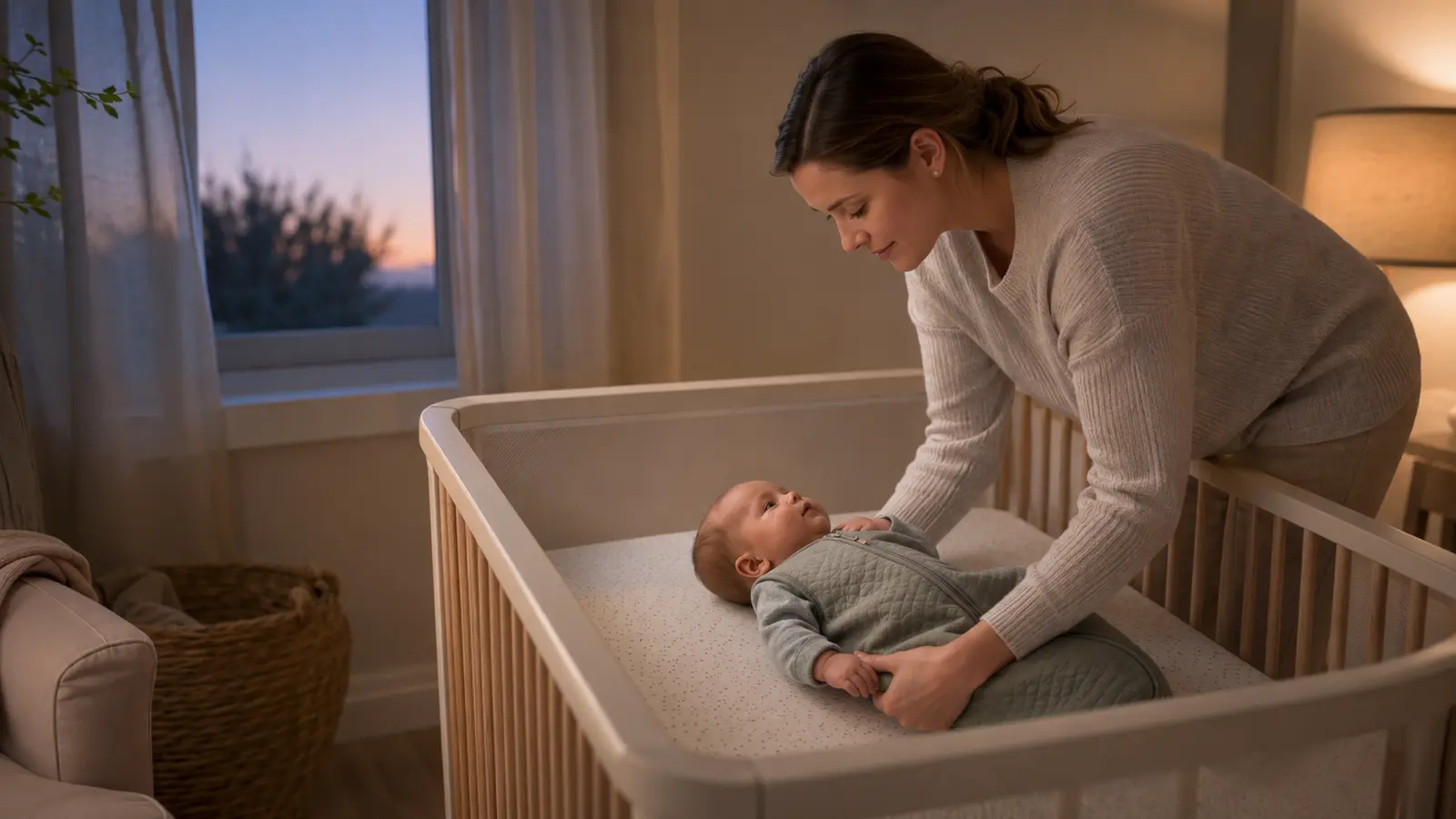
It's 2 a.m., and you're standing in the nursery swaying like you're on a boat, eyes half-closed, wondering if your baby has actually forgotten how to sleep or if you dreamed up those three glorious hours she slept last Tuesday. You've tried the shushing, the rocking, the pacifier dance—and yet here you are, awake again, Googling with one hand while patting a tiny back with the other.
Here's the thing: baby sleep isn't a puzzle you solve once and you're done. It's more like a recipe you adjust as you go, and some nights you nail it, and some nights you're just surviving on cold coffee and hope. But there are a few tried-and-true strategies that actually work—not because they're magic, but because they work with how babies are wired.
Let's talk about the stuff that actually helps.
📌 Quick Checklist — Save This
- Watch for drowsy cues before baby gets overtired and wired
- Keep the room dark during naps using blackout shades or curtains
- Start a simple bedtime routine you can do in 15 minutes
- Use white noise to drown out household sounds and startle reflexes
- Put baby down drowsy but awake at least once a day
- Track wake windows to avoid the overtired spiral
- Give yourself permission to do what works tonight, not what Instagram says
Understanding Baby Sleep Isn't Like Adult Sleep
Newborn sleep is irregular, and babies often wake every one or two hours. Frequent waking is biologically normal in early infancy, especially because newborns need to feed often.
If your baby wakes after being transferred to a crib, it does not mean you have done anything wrong. Sleep patterns and the ability to settle change gradually.
This is why some babies sleep great for the first stretch of the night (deep sleep) and then wake every hour after midnight (lighter sleep cycles). It's biology, not a personal attack on your sanity.
Watch the Wake Windows for Better Baby Sleep
Wake windows are the amount of time your baby can handle being awake before they need to sleep again. And they're shockingly short at first.
Young babies often have short awake periods, but there is wide variation. Follow your baby’s cues rather than treating a wake-window chart as a rule. If you miss early tired cues, your baby may become fussier and harder to settle.
You don't need an app or a spreadsheet. Just watch for the cues:
- Staring off into space or losing interest in toys
- Rubbing eyes or ears
- Getting fussy for no clear reason
- Yawning (the obvious one, but it's often the last cue before overtired kicks in)
When you see those signs, start your wind-down routine right then. Don't wait for the meltdown.
Create a Simple Bedtime Routine (and Stick to It)
Babies love predictability. A short, consistent bedtime routine signals to their brain: Hey, sleep is coming.
It doesn't have to be elaborate. In fact, shorter is better—15 to 20 minutes max. Here's a sample routine that works for a lot of families:
- Dim the lights in the room
- Change diaper and put on sleep sack
- Read one short book or sing a lullaby
- Feed (but try not to let them fall fully asleep during this)
- Lay them down drowsy but awake
Do it in the same order every night. Babies are pattern-recognition machines. With repetition, the routine may become a familiar signal that sleep is approaching.
The "Drowsy But Awake" Baby Sleep Tip Everyone Mentions (and Why It's Hard)
You've probably heard this one a thousand times: put your baby down drowsy but awake. And if you've tried it, you've probably thought, Yeah, okay, but my baby screams the second I lower her toward the mattress.
Here's the truth: this skill takes practice. And it doesn't mean your baby has to be barely awake. It just means they're not fully asleep in your arms.
You can try placing your baby down while still a little awake, but it will not suit every baby or every night. Rocking or feeding a young baby to sleep does not mean you have failed.
And some nights? You're going to rock them all the way to sleep and that's fine too. You're not ruining anything.
Make the Sleep Environment Work for You
Babies sleep better in rooms that are dark, cool, and a little bit noisy (weird, but true). Here's the setup that works for most families:
- Darkness: Use properly installed blackout shades if darkness helps, and keep cords and loose fabric well away from the crib.
- White noise: A fan, a sound machine, or even a white noise app on your phone. It masks household sounds and mimics the whooshing they heard in the womb. Keep sound machines at a low volume, follow the manufacturer’s instructions, and place them away from the crib.
- Cool temperature: Keep the room comfortable for a lightly clothed adult. Dress your baby appropriately and check for signs of overheating.
- Safe sleep setup: Firm mattress, fitted sheet, nothing else in the crib. Keep pillows, blankets, bumpers, positioners, stuffed toys, and other soft objects out of the baby’s sleep space throughout infancy.
These tweaks won't make your baby sleep through the night magically, but they will remove obstacles that might be waking them unnecessarily.
Day and Night Confusion Is Real for Newborn Sleep
If your newborn is partying at 3 a.m. and snoozing all afternoon, they've got their days and nights flipped. It happens because in the womb, your movement during the day rocked them to sleep, and nighttime—when you were lying still—was party time.
You can help reset their internal clock:
- Open curtains and get bright light exposure during the day (even just sitting near a window works)
- Keep daytime active and stimulating—talk, play, don't tiptoe around
- At night, keep everything low-key: dim lights, quiet voices, boring diaper changes
- Follow the feeding plan given by your pediatrician, especially for newborns, premature babies, or babies who are still establishing weight gain
Day and night patterns usually become clearer over time.
Feed Timing Affects Baby Sleep More Than You Think
Young babies need to feed frequently, including overnight. Follow hunger cues and the feeding plan recommended for your baby.
If your newborn is very sleepy during feeds or difficult to wake, ask your baby’s clinician or an IBCLC for guidance rather than trying to stretch the time between feeds.
If you bottle-feed, ask your baby’s clinician about paced feeding and follow your baby’s fullness cues.
And yes, some babies genuinely need a night feed (or two, or three) for months. That's normal. You're not failing if your four-month-old still wakes to eat.
Know When to Help and When to Wait
This one's hard because every expert says something different, and your gut is probably tired and confused.
Here's a gentle middle ground: when your baby wakes, take a brief moment to listen before going in, unless your baby needs feeding, is distressed, or you are concerned. Sometimes they're just shifting between sleep cycles and will settle on their own. Sometimes they're fully awake and need you.
You'll learn the difference between fussing (little grunts, squirms, brief cries) and true waking (escalating cries, full-on upset). Fussing often resolves itself. True waking needs your help.
And if you're not sure? Go to them. You're not teaching bad habits by responding. You're teaching them they're safe.
What to Do When Nothing's Working
Some nights, you'll do everything "right" and your baby still won't sleep. Teething, illness, growth, developmental changes, and ordinary variation can all disrupt sleep.
On those nights, your job isn't to fix it. Your job is to survive it.
Tag team with your partner if you can. Sleep in shifts. Let someone else hold the baby while you close your eyes for 20 minutes. Order takeout. Lower every standard that isn't about safety.
And remember: this phase is loud and hard and all-consuming, but it's also temporary. Not in a "cherish every moment" way—in a real, actual, this will end way.
🌸 Chill Moment
If your baby's sleep feels like a mess right now, it doesn't mean you're doing it wrong. Some babies are just terrible sleepers for a while, and it's not a reflection of your effort or your worth as a mom.
Your one thing for today
Pick just one tip from this list and try it tonight—not all of them, just one. That's enough.
Final Thoughts on Baby Sleep Tips
The night you finally get a four-hour stretch, you'll wake up in a panic thinking something's wrong—and then you'll realize your baby just slept, and you'll feel like you won the lottery and cried a little and immediately checked to make sure they're still breathing.
Longer stretches often come with time, but every baby’s pattern is different. And until then, you're doing an incredible job in the hardest, quietest hours when no one's watching.
Save this for later—screenshot it, bookmark it, or pin it so you've got it when you need a reminder at 3 a.m.
Safe sleep comes first
Put your baby on their back for every sleep on a firm, flat, non-inclined surface that meets current safety standards. Use only a fitted sheet. Keep pillows, blankets, bumpers, toys, positioners, and other soft items out of the sleep space.
Sources and further reading
Our editorial review used the following US health authorities: